

Whether You’re Walking or Driving Safety is Up to All of Us
Whether Your Walking or Driving Safety is Up to All of Us
Drive through intersections with care
-
Focus on the road. Always leave your phone or any other hand-held electronic device alone while you’re driving.
-
Be ready to yield to pedestrians – especially when turning in intersections and near transit stops.
-
Look twice for pedestrians crossing the road particularly when visibility is poor.
-
Give yourself extra time and space to stop in case a pedestrian suddenly crosses the street; expect the unexpected.
https://youtu.be/LdgtG3L75CE
Pedestrian safety
When drivers fail to yield, it’s pedestrians who pay the price. Busy intersections and shorter days mean that both pedestrians and drivers need to be extra careful during fall and winter.
As the weather changes and daylight hours decrease, pedestrians become increasingly vulnerable. Crashes involving pedestrians rise during the fall and winter, and 69 percent of these crashes occur at intersections. Whether it’s yielding the right of way or taking extra care to be seen, sharing our roads safely is everyone’s responsibility.
Be a safe pedestrian
-
Always make eye contact with drivers and never assume that a driver has seen you.
-
Remove your headphones and leave your phone alone while crossing the road.
-
Be careful at intersections and watch for drivers turning left or right through the crosswalk. Drivers may be focused on oncoming traffic instead of scanning for you.
-
Always cross at designated crosswalks. Follow pedestrian signs and traffic signals and never cross once the signal has turned yellow or red.
-
Wear reflective clothing or gear and flashlights to make it easier for drivers to see you in wet weather, at dusk and at night.
-
On rural roads without sidewalks, make yourself visible and always walk facing traffic so you can see oncoming drivers.
Look, Listen and Be Seen
LOOK, LISTEN AND BE SEEN
ICBC is launching a new education campaign across the province to help keep pedestrians safe this fall and winter when crashes involving pedestrians increase significantly in B.C.
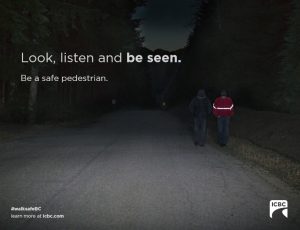 On average, 76 per cent more pedestrians are injured in crashes from November to January every year when conditions are dark and weather is poor compared to June to August in B.C.*
ICBC is partnering with TransLink, Transit Police and BC Transit with new advertising featured on SkyTrains and in buses across B.C. to reach pedestrians on transit.
ICBC and community policing volunteers throughout B.C. will also be handing out pedestrian safety reflectors and tips at events throughout the province to help educate pedestrians about the importance of being visible to drivers in dark, fall conditions.
In a new ICBC survey, 76 per cent of drivers and 83 per cent of pedestrians stated they’re concerned about hitting a pedestrian or being hit by a driver in an intersection. Yet, on average, 75 per cent of crashes with pedestrians still occur at intersections in B.C.
Know how to recognize a scam
Know how to recognize a scam:
There are many fraud types, including new ones invented daily.
Taxpayers should be vigilant when they receive, either by telephone, mail, text message or email, a fraudulent communication that claims to be from the Canada Revenue Agency (CRA) requesting personal information such as a social insurance number, credit card number, bank account number, or passport number.
These scams may insist that this personal information is needed so that the taxpayer can receive a refund or a benefit payment. Cases of fraudulent communication could also involve threatening or coercive language to scare individuals into paying fictitious debt to the CRA. Other communications urge taxpayers to visit a fake CRA website where the taxpayer is then asked to verify their identity by entering personal information. These are scams and taxpayers should never respond to these fraudulent communications or click on any of the links provided.
To identify communications not from the CRA, be aware of these guidelines.
http://www.cra-arc.gc.ca/scrty/frdprvntn/menu-eng.html
Thank you for keeping our communities safer…
South Cowichan Community Policing
250-929-7222
sccp@shaw.ca
